The Significance of Al-Isra’ wal-Mi’raj
Al-Isra’ wal-Mi’raj (the Night Journey & Ascension) is a miracle second only to the revelation of the Qur’an, and it is therefore important that we don’t let this night slip by without reflecting on its lessons and its significance. Al Isra’ wal-Mi’raj 2025 is predicted to take place on January 26th 2025, depending on the sighting of the moon. To study Islamic teachings deeply, check out our online Quran Courses.
Many of us only know the basic story of Al-Isra’ wal-Mi’raj – that the Prophet (saw) was transported from al-Masjid al-Haram to al-Masjid al-Aqsa, from where he (saw) ascended to heaven. In fact, there were many stops along this incredible journey, and the story is packed with wonders and miracles. This blog will narrate the first half of the Miraculous Journey and we have included as much detail as we could.
Context of Al-Isra’ wal-Mi’raj
Al-Isra’ wal-Mi’raj took place during a time when the Prophet (saw) was facing intense hardship and pain. The Quraysh, who were his tribe and his family, constantly ridiculed, humiliated and oppressed the Prophet (saw) and his followers. Moreover, the Prophet (saw) had just faced the Year of Sorrow (’Aam al-Huzn), during which he (saw) lost his beloved wife Khadijah (ra), and his uncle Abu Talib, who was his protector and ally.
In addition to all these burdens, when the Prophet (saw) had travelled to Ta’if to spread the Islamic message, the people of Ta’if had rejected him in the most cruel way, sending their children into the streets to stone him until he left the city.
Having gone through so much grief and suffering, the Prophet Muhammad (saw) was given a truly beautiful and comforting gift. He was transported not only to the Sacred Sanctuary and through the skies, but ultimately into the Divine Presence, the source of all comfort and hope. One of the most important lessons of Al-Isra’ wal-Mi’raj, therefore, is that ‘with every hardship [there will be] ease’ (The Noble Qur’an, 94: 5).
Al-Isra’: From the Ka’bah to Al-Aqsa
When the Prophet (saw) was sleeping in the house of Umm Hani (ra) in Makkah he said, ‘the roof of my house was opened and the Angel Jibril [as] descended’ (Bukhari). Scholars reconciling between various narrations, say the Prophet (saw) was then taken to the Hijr, the semi-circular wall of the Ka‘bah, where the Prophet (saw) said that Jibril (as), ‘opened my chest, and washed it with Zamzam water. Then he brought a golden tray full of wisdom and faith, and having poured its contents into my chest, he closed it’. [Bukhari]
The Prophet (saw) continued, ‘I was then brought a white beast which is called al-Buraq [from the Arabic word barq, meaning lightning], bigger than a donkey and smaller than a mule. Its stride was as long as the eye could reach’. [Muslim]
It is narrated by Anas (ra) that Buraq was, ‘saddled and reined, but he shied from him (saw). So Jibril [as] said to him, “Is it from Muhammad [saw] that you do this? For nobody has ridden you who is more honourable to Allah than him!” He said, “Then he started sweating profusely”’. [Tirmidhi]
At several points along the journey, Jibra’eel (as) stopped Buraq and told the Prophet (saw), ‘Dismount and pray’. The first stop was at ‘the place of emigration’ i.e. Madinah – and soon after this night the Prophet (saw) would meet the Ansar and migrate to Madinah. The second stop was at Mount Sinai, where Allah (swt) revealed the Torah to Musa (as). The third stop was at Bethlehem, where ’Isa (as) was born.
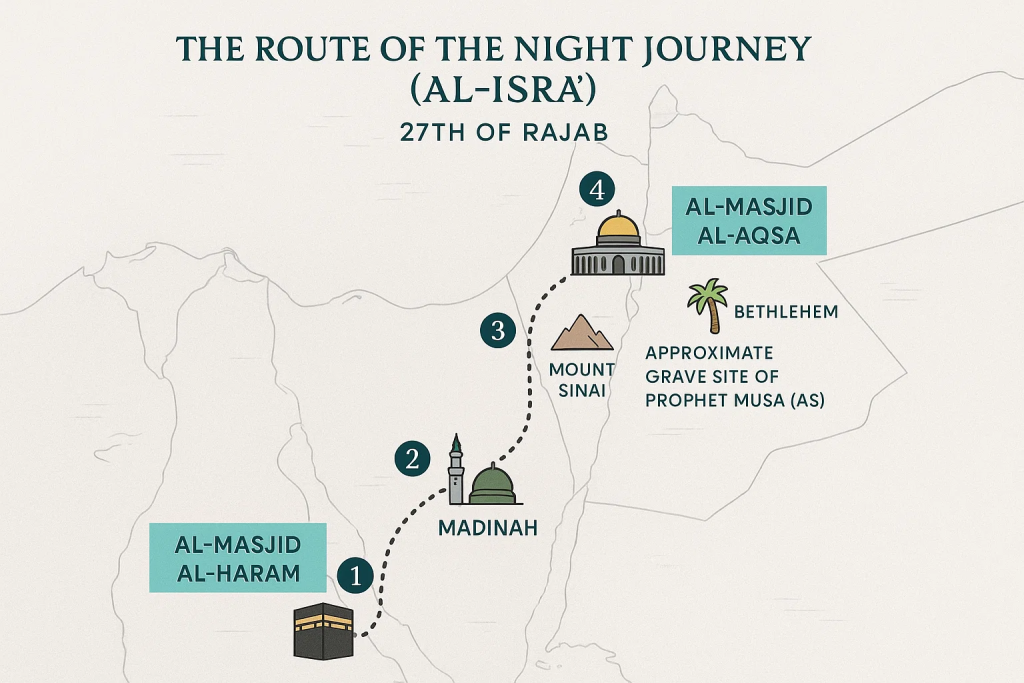
Stops Along the Blessed Journey
‘I happened to pass by Musa [as] on the night of my Night journey by the red sandhill whilst he was standing praying in his grave’ (Muslim). We know that his grave is located, ‘a stone’s throw’ away from the holy land of the Blessed Masjid Al-Aqsa (Bukhari). This incident clearly shows us an example of what the Messenger of Allah (saw) said about Prophets (as) after they pass away that, ‘The Prophets are alive in their graves praying’ (Abu Ya‘la).
Arrival at Al-Aqsa
Finally, the Messenger of Allah (saw) arrived in the holy city of Al-Quds (Jerusalem) and he said, ’When we reached Bait al-Maqdis [literally ‘the holy house’ another name for the Blessed Masjid Al-Aqsa] Jibril (as) pointed with his finger causing a crack in the rock, and he tied the Buraq to it [at the western wall of the noble sanctuary]’ (Tirmidhi). Waiting inside were all 124,000 Prophets (as). Jibra’eel (as) led the Prophet (saw) to the front, and he (saw) led them all in prayer in this blessed space.
Some narrations indicate that the Prophet (saw) prayed ‘two units of prayer’ (Muslim) to greet the Masjid (known as Tahiyyat al-Masjid). This is one of the first examples of this established Sunnah of the Prophet (saw). It is also mentioned that Jibril (as) called the Adhan (call to prayer) before this practice was even established later in Madinah and that the angels from the heavens descended to pray behind all the Prophets in this sacred place – Subhan-Allah!
When the Prophet (saw) completed the prayer, he said, ‘someone said, “Here is Malik (as), the keeper of the Hell, so convey Salams to him”. So, I turned to him, but he preceded me in Salams’ (Muslim).
The Messenger of Allah (saw) also said, ’The Prophets were presented to me, and Musa (as) was a thin man, it was as if he was from the men of Shanu’ah [a Yemeni tribe]. And I saw ’Isa ibn Maryam (as), and the closest of the people in resemblance to him from those I have seen, is ‘Urwah ibn Mas‘†d (ra). And I saw Ibrahim (as), and the closest of the people in resemblance to him, from those I have seen, is your companion [meaning himself]. And I saw Jibril [as], and the closest of the people in resemblance to him, from those I have seen, is Dihyah (ra)’ (Tirmidhi).
Discussions About the Hour
Part of what the Prophets (as) discussed after praising Allah was about ‘the Hour’. Both Ibrahim (as) and Musa (as) stated that they ‘did not have any knowledge of it’. Whilst ’Isa (as) ’mentioned the Dajjal (anti-Christ) and said,
“I will descend and kill him, then the people will return to their own lands and will be confronted with Gog and Magog, who will, “swoop down from every mound” [Qur’an, 21:96]”’. [Ibn Majah]
Following this, the Prophet (saw) said, ‘Then I came out and Jibril (as) brought me a vessel of wine and a vessel of milk. Then I chose the milk, and Jibril (as) said, “You have chosen the natural state (Fitrah)”’ (Muslim).
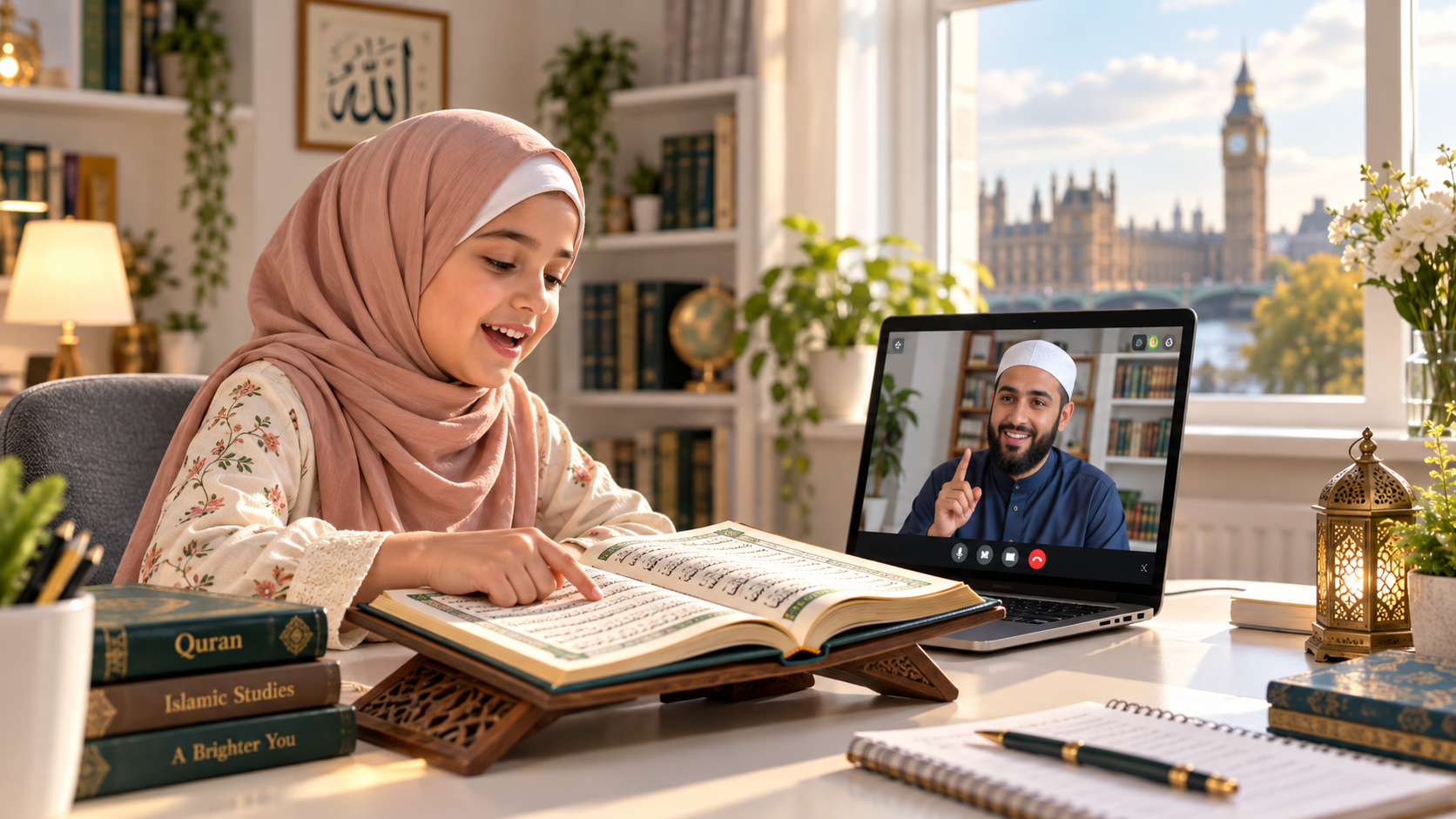
Teaching children the profound milestones of Islamic history helps deepen their connection to the faith. Bring sacred events like Al-Isra wal-Miraj to life with our expert-led online Quran and Islamic studies classes designed for families in the US and UK.
The Beginning of the Mi’raj (Ascension)
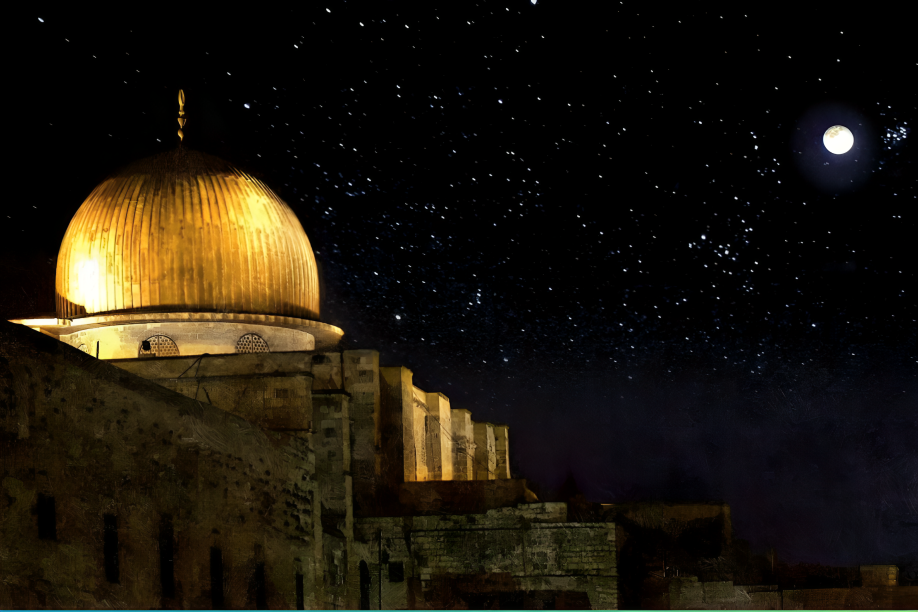
The dominant opinion is that the Prophet (saw) alongside Jibril (as) then proceeded to the Noble Rock (as-Sakhrah al-Musharrafah) that is currently housed by the holy Dome of the Rock Masjid at the centre of the noble sanctuary (al-Haram ash-Sharif) of the Blessed Masjid Al-Aqsa. He (saw) ascended into the heavens for the next part of this incredible journey, the Mi‘raj,
Al-Isra’ wal-Mi’raj holds great significance to every Muslim across the globe, where the Prophet Muhammad’s (PBUH) ascension is remembered and the definitive purpose of it is recollected. It is viewed as a standout amongst the most sacred of miracles of the Almighty, which He offered to Prophet Muhammad (PBUH) and just him.To learn more about authentic Islamic history and strengthen your Quranic recitation with expert guidance, explore our Online Quran Classes & Free Trial.
Understanding the Spiritual Lessons of Isra wal-Miraj for Modern Muslim Families
For Muslim parents living in the US, UK, and Western societies, teaching children about historical milestones like Al-Isra wal-Miraj is vital for building a strong, confident Islamic identity. Beyond the miraculous night journey from Makkah to Jerusalem and the ascension through the heavens, this event holds deep practical lessons for our daily lives.
- The Pillar of Salah (Prayer): The direct gift of the five daily prayers given on this night serves as our daily anchor, keeping families connected to Allah amidst busy Western schedules.
- Perseverance in Times of Hardship (Aam al-Huzn): The journey occurred during a difficult year for Prophet Muhammad (PBUH), reminding believers that relief and divine ease always follow patience and steadfastness.
- Nurturing Faith at Home: Integrating authentic Islamic history and Quranic teachings into children’s education helps them navigate modern challenges with strong moral clarity and spiritual grounding.
Al-Isra Wal Miraj refers to the miraculous night journey of Prophet Muhammad (PBUH) from Makkah to Al-Aqsa Mosque in Jerusalem (Isra), followed by his ascension to the heavens (Miraj) in a single night by the will of Allah.
This event holds immense significance because it tested the faith of believers, showcased the high status of Prophet Muhammad (PBUH), and is the blessed occasion during which the five daily prayers (Salah) were made obligatory.
Want to Deepen Your Islamic & Quranic Knowledge?
Learn Quran reading, Tajweed, and Islamic studies with expert 1-on-1 online tutors from the comfort of your home.
Book a Free Trial Class →Continue the journey by reading our latest blog now….