
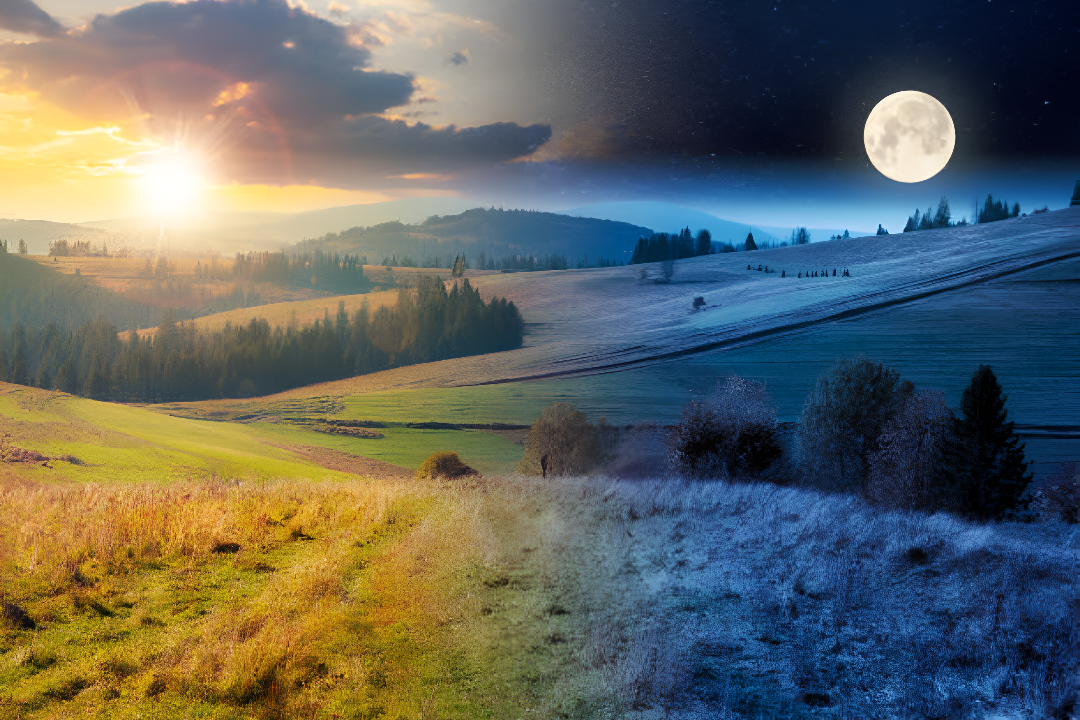
يُقَلِّبُ اللَّهُ الَّيْلَ وَالنَّهَارَ إِنَّ فِى ذلِكَ لَعِبْرَةً لأُوْلِى الاٌّبْصَـرِ
Allah alternates the night and the day. Indeed in that is a lesson for those who have vision.
(Surah An-Nur: 44)
The Quran and the Phenomenon of Day and Night
The phenomenon of day and night is beautifully described in the Quran, offering profound lessons for those who reflect upon it. The alternation of day and night reminds us of the greatness of Allah (Subhana’wata’ala) and His perfect design in the universe.
The Arabic word يُقَلِّبُ comes from the root ق ل ب, meaning “to flip, alternate, or change something from one state to another.” In the Quran, it is used to describe how Allah causes day and night to succeed one another. Just as the word قلب is also used for the heart—whose state changes under different circumstances—the alternation of day and night demonstrates a complete transformation: daylight removes the darkness of night, and nighttime covers the brightness of day. This shift does not occur by chance; it happens under Allah’s command, power, knowledge, and will.
The word نَھَر (day) is the opposite of لَیل (night). Daytime begins at sunrise and ends at sunset, roughly lasting 12 hours, while a full day of 24 hours starts at sunset and ends at the next day’s sunset. Time and human age are measured by these cycles.
From a scientific perspective, the Earth takes 24 hours to complete one full rotation on its axis, which passes through the North and South Poles. This rotation creates day and night. The changing lengths of day and night throughout the year depend on your location on Earth and the tilt of the Earth’s axis as it orbits the Sun.
Lessons from the Alternation of Day and Night
The alternation of day and night serves a clear purpose. Continuous sunlight can increase temperatures, tire living beings, and mentally fatigue humans, but the darkness of night brings rest and restoration. Allah created day and night as signs for humanity, allowing people to work, travel, worship, and organize their lives according to time. These cycles also help humans measure days, weeks, months, and years, setting appointed times for worship, transactions, and other responsibilities.
The gradual changes of day and night also lead to the formation of the four seasons, influencing plant growth, rainfall, and water storage in the earth. The sun symbolizes the day, while the moon signifies the night.
Allah reminds us:
إِنَّ فِى ذلِكَ لَعِبْرَةً لأُوْلِى الاٌّبْصَر
“Indeed, in this are signs for those who have insight.”
These signs are meant for those with insight and faith—not merely physical sight. They point to the understanding of the heart (iman), guiding people to contemplate Allah’s wisdom, decree, and perfect planning. Nothing in creation is random or purposeless.
May Allah (Subhana’wata’ala) bless us with clear vision, sound understanding of the deen, and true iman, so that we may recognize His signs, obey His commands, and benefit from His wisdom. Ameen.
ALSO KNOWN :