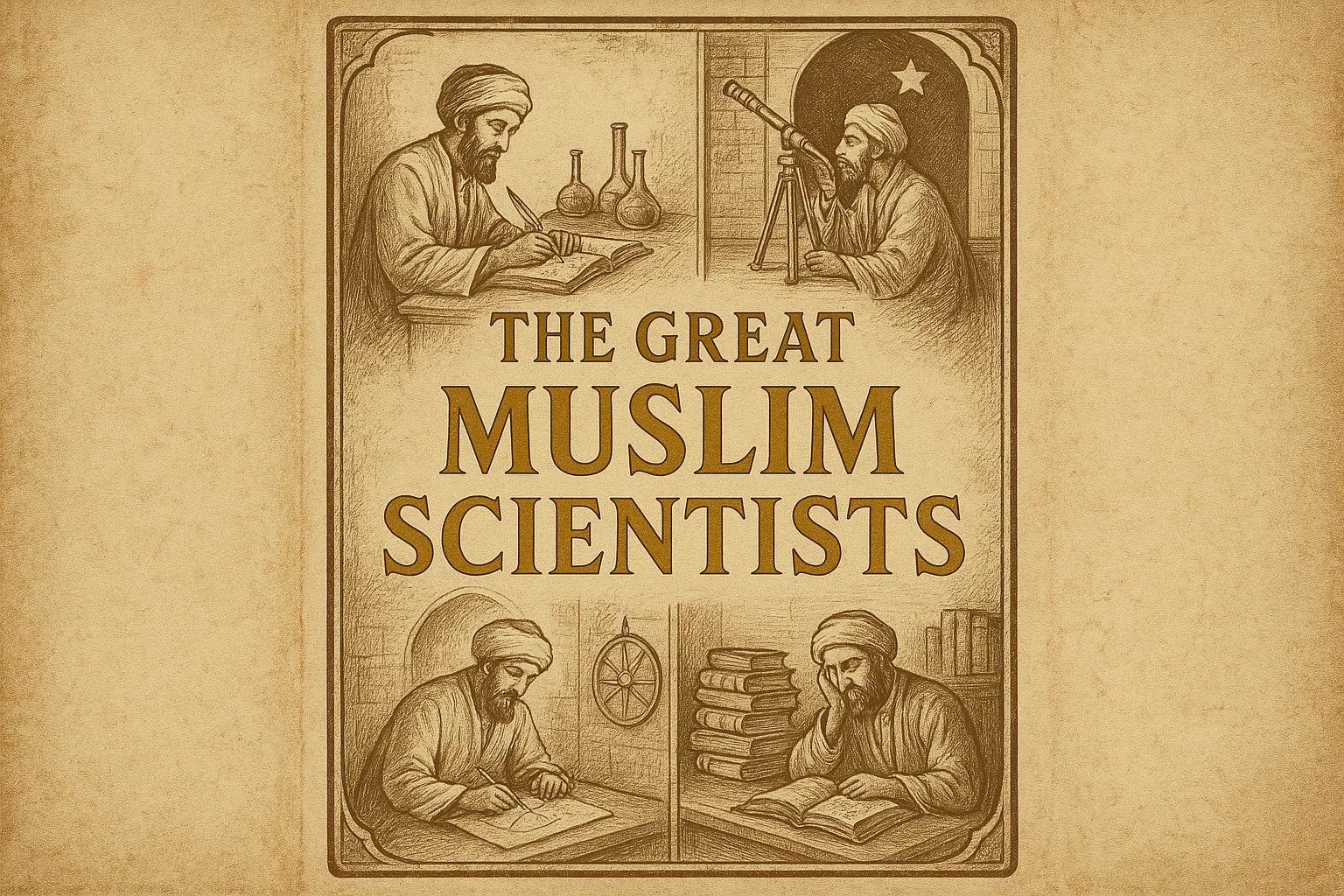
10 Greatest Muslim Scientists Who Transformed the World
The Islamic Golden Age, spanning from the 8th to the 14th centuries, remains one of the most extraordinary periods in human history, marked by immense scientific progress, intellectual growth, and cultural brilliance. It was during this era that some of the world’s most influential Muslim scholars emerged, whose discoveries and innovations continue to shape modern science. These 10 greatest Muslim scientists and Islamic science heroes made groundbreaking contributions in fields such as astronomy, mathematics, medicine, chemistry, and philosophy.
During this transformative period, Muslim scholars preserved invaluable knowledge from earlier civilizations, including Greek, Persian, and Indian works. They didn’t merely safeguard these legacies but expanded on them, conducting original research, experiments, and intellectual analysis. Their discoveries bridged ancient wisdom with emerging modern scientific understanding, leaving a lasting global impact.
The achievements of these pioneering Muslim scientists not only advanced the Islamic world but also played a critical role in shaping European scientific progress during the Renaissance. Recognizing and honoring their contributions highlights the depth of Islamic scientific heritage and underscores the shared pursuit of knowledge that transcends borders and generations.
وَقُل رَّبِّ زِدْنِي عِلْمًا
And say, “My Lord, increase me in knowledge.”
(Qur’an, 20:114)
10 Greatest Muslim Scientists
1. Al-Khwarizmi (c. 780–850 CE)
- Founder of Algebra: Developed foundational algebraic concepts and algorithms, with his book Al-Kitab al-Mukhtasar fi Hisab al-Jabr wal-Muqabala giving rise to the term “algebra.”
- Mathematical Innovation: Introduced Hindu-Arabic numerals, transforming computation and calculations.
- Astronomy & Geography: Improved astronomical tables and created influential maps of the known world.
- Legacy: His works laid the foundation for mathematics and computer science in both the Islamic and European worlds.
2. Ibn Sina (Avicenna) (980–1037 CE)
- Medicine: Authored The Canon of Medicine, which served as a key medical reference in Europe and the Islamic world for centuries.
- Pharmacology & Anatomy: Documented hundreds of drugs and detailed human anatomy, promoting evidence-based medicine.
- Philosophy & Ethics: Integrated Aristotelian philosophy into Islamic thought and emphasized medical ethics and standardized patient care.
3. Ibn al-Haytham (Alhazen) (965–1040 CE)
- Optics Pioneer: Demonstrated that vision occurs when light reflects off objects and enters the eye, revolutionizing optics.
- Empirical Science: Applied experiments and observations, anticipating the modern scientific method.
- Physics & Mathematics: Advanced studies in refraction, reflection, and lens mechanics, influencing the camera obscura.
- Impact: Inspired Renaissance scientists like Kepler, Newton, and Leonardo da Vinci.
4. Al-Razi (Rhazes) (865–925 CE)
- Medicine: Compiled Kitab al-Hawi, a comprehensive medical encyclopedia of global influence.
- Chemistry: Classified minerals, plants, and animals, and developed laboratory procedures.
- Hospital Innovations: Founded hospitals with specialized wards and hygiene standards.
- Surgical Advancements: Developed surgical tools and techniques still in modified use today.
5. Al-Biruni (973–1048 CE)
- Astronomy: Accurately measured the Earth’s radius and created advanced astronomical tables.
- Geography: Calculated latitude and longitude, explained Earth’s rotation, and mapped the known world.
- Anthropology: Explored cultures and religions in Kitab al-Hind.
- Mathematics: Created precise trigonometric methods and tables.
6. Ibn al-Nafis (1213–1288 CE)
- Anatomy: Discovered pulmonary blood circulation, correcting longstanding Galenic errors.
- Medical Texts: Authored extensive works on physiology, surgery, and medical philosophy.
- Scientific Method: Emphasized verification and observation, influencing Islamic and European medicine.
7. Jabir ibn Hayyan (Geber) (c. 721–815 CE)
- Chemistry Pioneer: Introduced systematic lab techniques such as distillation, crystallization, and evaporation.
- Acid Discovery: Identified acids including hydrochloric, nitric, citric, and acetic acids.
- Laboratory Instruments: Innovated tools for chemical experimentation.
8. Al-Farabi (872–950 CE)
- Philosophy & Logic: Harmonized Aristotle, Plato, and Islamic philosophy, impacting ethics, metaphysics, and logic.
- Political Science: Wrote on governance, social harmony, and civics.
- Music & Mathematics: Formulated mathematical approaches to music theory, influencing both East and West.
9. Ibn Rushd (Averroes) (1126–1198 CE)
- Philosophy: Produced extensive commentaries on Aristotle, shaping both Islamic and European philosophical thought.
- Medicine: Authored influential texts on diseases and therapeutics.
- Law & Ethics: Expanded legal and ethical understanding in Islam and Western philosophy.
- Astronomy: Critiqued Ptolemaic models and made contributions to planetary theory.
10. Ulugh Beg (1394–1449 CE)
- Astronomy: Founded the Samarkand observatory and conducted precise stellar observations.
- Star Catalog: Compiled the Zij-i Sultani, one of the most accurate star catalogs of its era.
- Mathematics: Advanced trigonometry and improved astronomical calculations.
- Mentorship: Nurtured a generation of astronomers, fostering scientific growth in Central Asia.
هُوَ الَّذِي جَعَلَ لَكُمُ الْأَرْضَ ذَلُولًا فَامْشُوا فِي مَنَاكِبِهَا وَكُلُوا مِن رِّزْقِهِ ۖ وَإِلَيْهِ النُّشُورُ
“It is He who made the earth tame for you – so walk among its slopes and eat of His provision – and to Him is the resurrection.” (Qur’an, 67:15)
Legacy and Influence
These Muslim science pioneers laid the groundwork for modern scientific disciplines, from algebra and the decimal system to optics, medicine, and pharmacology. Their translations and writings rejuvenated European learning during the Renaissance, fueling the Scientific Revolution. Figures like Al-Khwarizmi, Ibn Sina, and Ibn al-Haytham directly influenced thinkers such as Copernicus, Galileo, and Newton.
The legacy of these Muslim scientists continues to inspire education, research, and innovation worldwide. Their pursuit of knowledge demonstrates that intellectual curiosity and scientific exploration are universal values that transcend time and geography. By celebrating these Islamic science heroes, we honor a shared human heritage of curiosity, creativity, and discovery.
FAQs:
Q1: Who are considered the greatest Muslim scientists in history?
A1: Some of the most influential Muslim scientists include Al-Khwarizmi, Ibn Sina (Avicenna), Ibn al-Haytham (Alhazen), Al-Razi (Rhazes), Al-Biruni, Ibn al-Nafis, Jabir ibn Hayyan (Geber), Al-Farabi, Ibn Rushd (Averroes), and Ulugh Beg. They made major contributions in fields such as mathematics, medicine, astronomy, chemistry, and philosophy.
Q2: What were Al-Khwarizmi’s major contributions to science?
A2: Al-Khwarizmi is known as the “Father of Algebra.” He developed algebraic methods, introduced Hindu-Arabic numerals, and improved astronomical tables and maps. His works laid the foundation for modern mathematics and computer science.
Q3: How did Ibn Sina (Avicenna) influence medicine?
A3: Ibn Sina wrote The Canon of Medicine, a key medical reference in both the Islamic world and Europe for centuries. He documented anatomy, pharmacology, and emphasized evidence-based medicine and medical ethics.
Q4: Why is Ibn al-Haytham (Alhazen) important in the history of optics?
A4: Ibn al-Haytham revolutionized optics by proving that vision occurs when light reflects off objects into the eye. He used experiments and observations that anticipated the modern scientific method and influenced later scientists like Kepler and Newton.
Q5: What discoveries did Al-Razi make in medicine and chemistry?
A5: Al-Razi authored Kitab al-Hawi, classified minerals, plants, and animals, and introduced new laboratory methods. He also founded hospitals with specialized wards and improved hygiene and surgical procedures.
Q6: Who was Al-Biruni, and what were his contributions?
A6: Al-Biruni was an astronomer, mathematician, and geographer who measured the Earth’s radius, calculated latitude and longitude, studied Earth’s rotation, and explored different cultures in Kitab al-Hind. He also developed precise trigonometric methods.
Q7: What role did Ibn al-Nafis play in medical history?
A7: Ibn al-Nafis discovered pulmonary blood circulation, correcting centuries of medical errors. His writings on physiology, surgery, and medical philosophy promoted verification and observational study.
Q8: How did Jabir ibn Hayyan (Geber) contribute to chemistry?
A8: Known as the “Father of Chemistry,” Jabir ibn Hayyan introduced systematic laboratory techniques such as distillation, crystallization, and evaporation. He discovered several acids and developed laboratory instruments.
Q9: Who were other notable Muslim scientists apart from the main 10?
A9: Additional significant figures include Al-Zahrawi (Father of Surgery), Al-Kindi (Philosopher and Mathematician), Mariam al-Asturlabi (female astronomer), Al-Jazari (engineer and inventor), Ibn Khaldun (historian and sociologist), and Fatima al-Fihri (founder of the University of Al-Qarawiyyin).
Q10: How did Muslim scientists influence the European Renaissance?
A10: Their preserved and translated works introduced key knowledge in mathematics, medicine, astronomy, and philosophy to Europe, fueling the Renaissance and shaping the Scientific Revolution. Scholars like Al-Khwarizmi, Ibn Sina, and Ibn al-Haytham directly influenced thinkers such as Copernicus, Galileo, and Newton.
Q11: Why is it important to study the achievements of Muslim scientists?
A11: Studying their achievements helps recognize the rich scientific heritage of the Islamic world, inspires innovation, and emphasizes the universal value of knowledge, intellectual curiosity, and collaboration across cultures and centuries.
Q12: Are there female Muslim scientists recognized in history?
A12: Yes. Mariam al-Asturlabi was a pioneering female astronomer and astrolabe maker, and Fatima al-Fihri founded the University of Al-Qarawiyyin, one of the oldest continuously operating educational institutions in the world.
Final Thought
The extraordinary achievements of these Muslim scientists remind us that the pursuit of knowledge transcends time, culture, and geography. Their innovations in mathematics, medicine, astronomy, chemistry, and philosophy not only advanced the Islamic world but also profoundly influenced global scientific progress, laying the foundations for the Renaissance and modern science. Celebrating the legacy of these Islamic science heroes honors a shared human heritage of curiosity, creativity, and intellectual exploration. By studying and appreciating their work, we are inspired to carry forward their spirit of discovery, innovation, and a relentless quest for understanding the universe around us.
Explore the Legacy of Muslim Scientists and Ignite Your Curiosity
The stories of these 10 greatest Muslim scientists show that knowledge, curiosity, and innovation know no boundaries. Their discoveries continue to inspire generations and remind us that learning is a lifelong journey.
Ready to dive deeper? Discover more about Islamic scientific heritage, explore educational resources, and be inspired to pursue your own path of innovation and discovery.